13 Facts About the Amalfi Coast That Surprise First-Time Visitors
The short answer
The Amalfi Coast was an independent republic, wrote the sea law the Mediterranean used until 1570, lost its harbour to a tsunami in 1343, had no road until 1832 and has no railway now. What UNESCO protects is the landscape rather than any building on it.
Most of what makes this coast interesting is not the view, which you can get from a photograph. It is that a town of a few thousand people on a cliff ran a trading state, and that almost everything you see — the terraces, the road, the shape of the towns — is a consequence of the geography rather than a decoration on it. Here are thirteen things worth knowing before you go.
1. It was an independent state for more than two centuries
Amalfi broke away from the Duchy of Naples in 839 and governed itself until 1073, electing its first duke in 958. Between 839 and around 1200 it was one of the significant trading powers of the Mediterranean.
2. It wrote the law the Mediterranean used for five hundred years
The Tavole amalfitane set out how ships, cargoes and crews were to be treated, and the code was recognised across the Mediterranean until 1570. A town of a few thousand people wrote the rules everybody else sailed under.
3. A tsunami ended it, in 1343
A wave destroyed Amalfi's port and lower town in 1343. The harbour never came back, and the town has never since been more than locally important. The flat ground on the seafront today is the part that was rebuilt afterwards.
4. Europe learned paper-making here, from the Arab world
Amalfi was among the first paper-making centres in Europe and acquired the technique from the traders it dealt with. The mills stood in the Valle dei Mulini behind the town, and one of them still works as a museum.
5. There was no road until 1832
Ferdinand II of Bourbon ordered a coast road built in 1832; it was widened, bridged and buttressed into something carriages could use by about 1850. Before that the towns were reached on foot, by mule track or by sea.
6. The road is 50.36 kilometres long and has over a thousand bends
The Strada Statale 163 Amalfitana was numbered in 1953 when ANAS took it over. For most of its length it is cut into the rock face, and it goes straight through the middle of Positano.
7. On the busiest days, half of all cars are banned from it
An alternate-plate scheme runs on the SS163 between Vietri sul Mare and Positano from 10:00 to 18:00: even days admit even plates, odd days odd. Motorbikes, residents, blue-badge vehicles, taxis and buses are exempt.
8. Not one of the thirteen towns has a railway station
There is no railway on the Amalfi Coast at all. Sorrento and Salerno are the nearest rail heads, and everything else happens by road or by water.
9. The smallest comune in Italy is on this coast
Atrani covers 0.12 square kilometres, which makes it the smallest municipality in the country by area. Its population was 832 in 2020, and it has been documented as a settlement since 596. It is a ten-minute walk from Amalfi and the coaches do not stop.
10. Wagner found Klingsor's garden in Ravello
Villa Rufolo was built in 1270 and appears in Boccaccio's Decameron. Richard Wagner visited in 1880 and took its garden for Klingsor's in Parsifal. The Ravello Festival has run in his honour since 1953.
11. The lemons are a protected variety, and they hold the cliff up
The Sfusato Amalfitano is registered as Limone Costa d'Amalfi IGP across all thirteen comuni. It grows under pergolas of chestnut poles on terraces cut into the rock, and those terraces are also the coast's landslide defence.
12. Cetara makes Italy's first DOP fishery product
Colatura di alici di Cetara, the amber sauce pressed from salted anchovies, was granted DOP status in October 2020 — the first Italian fishery product ever to receive it. It is the direct descendant of Roman garum.
13. What UNESCO listed is the landscape, not the buildings
The Costiera Amalfitana was inscribed on 7 December 1997 under three cultural criteria, covering 11,231 hectares. The citation describes a Mediterranean landscape of exceptional cultural and natural scenic value produced by its topography and its history — cliffs, terraces, towns and sea together.
Where to see each of these on the ground
| What | Where | Getting to it |
|---|---|---|
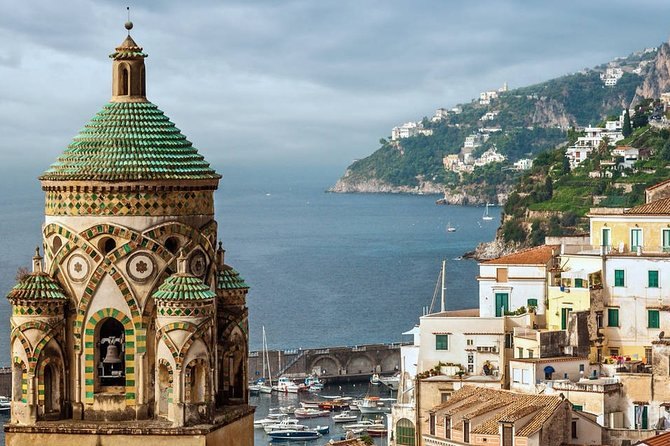
| The republic's cathedral | Amalfi, Piazza Duomo | Every road tour stops within three minutes of the steps |
| The paper mills | Valle dei Mulini, behind Amalfi | A twenty-minute walk up the valley from the piazza |
| The rebuilt lower town | Amalfi seafront | The flat ground you land on off the ferry |
| The Bourbon road | The SS163, end to end | Any road tour, or the SITA bus |
| The terraces and pergolas | Every hillside between Positano and Vietri | Best seen from the water |
| The smallest comune | Atrani | Ten minutes' walk east from Amalfi |
| Wagner's garden | Villa Rufolo, Ravello | Twenty-five minutes up the valley road, admission at the gate |
| Italy's first DOP fish sauce | Cetara | Near the eastern end, on the SS163 and the ferry route |
What each of them changes about a visit
Two of these facts are practical rather than historical, and they are the two worth acting on. The absence of a railway means every plan you make starts with Sorrento or Salerno, and the alternate-plate rule means a hire car may be illegal on the coast road on the day you wanted to use it. Both point the same way, which is why so much of what is listed here comes with a driver or a skipper attached.
The rest are the reason the coast is more interesting than its photographs. A landscape that was terraced by hand to grow lemons, roaded by a king in 1832 and listed by UNESCO in 1997 is not scenery: it is a working place that has been rebuilt after every disaster it has had. That is visible from the water in a way it is not from the road.
Where to see all of this
The republic, the wave and the road are all still legible on the ground. The Duomo di Sant'Andrea and the paper museum are in Amalfi; the terraces are visible from any boat; the road is the road. The history of the coast sets them out in order, and the towns page says which town holds what.
The one that is hardest to see and easiest to taste is the food: the lemons, the colatura and the Costa d'Amalfi DOC are all on the food and wine page, and several of the trips listed here go to the farms that make them.
💡 Useful tip. If you want the history rather than the view, give Amalfi two hours rather than one, and walk up the Valle dei Mulini behind the town. Most day tours give you exactly enough time to do it.
What you will not find here
A ticket office. The coast has no gate, no admission and no opening hour: it is thirteen working towns and a public road. What you pay for is transport, the occasional villa or grotto, and the person who does the driving.
Days that put you where the history is
Day Tour to Positano, Amalfi & Ravello from Sorrento
Two hours in Amalfi, which is what the Duomo and the mills need.
From $109 per person
Check AvailabilityPompeii and Herculaneum Small Group Tour with an Archaeologist
The Roman layer under all of it, with an archaeologist explaining.
From $75 per person
Check AvailabilitySorrento Farm and Food Experience including Olive Oil, Limoncello, Wine tasting
The lemon and olive terraces, walked rather than looked at.
From $111 per person
Check Availability