How to Visit the Amalfi Coast in 2026: Tours, Ferries and Buses
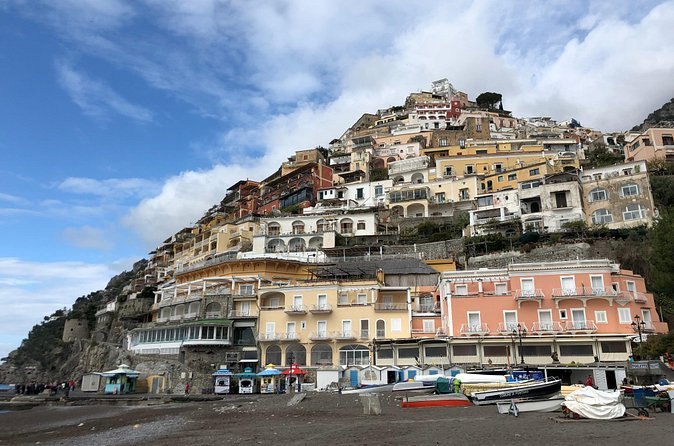
The short answer
Fly or train to Naples, get to Sorrento or Salerno, and go on from there by boat, bus or tour — there is no railway station on the coast itself. Come in May, June, September or early October. Give it three nights if you can and one day if you cannot, and let somebody else drive.
Where the Amalfi Coast actually is
The Sorrentine Peninsula runs west into the Tyrrhenian Sea south of Naples. Sorrento sits on the north side of it, facing the Bay of Naples. The Amalfi Coast is the south side, facing the Gulf of Salerno, and it runs roughly fifty kilometres west to east from Positano to Vietri sul Mare, where Salerno begins.
Thirteen comuni sit on it. Eleven are at sea level in ravines, Ravello and Scala are hundreds of metres up, and Tramonti is behind the ridge entirely. UNESCO inscribed the whole landscape — 11,231 hectares of it — on the World Heritage List in December 1997, and what is listed is the relationship between the cliffs, the terraces and the towns rather than any single building. The towns of the coast takes them one at a time.
Is there a train to the Amalfi Coast?
No, and it is the single most useful thing to know before you plan anything. Not one of the thirteen towns has a railway station. The nearest rail heads are Sorrento, at the end of the Circumvesuviana commuter line from Naples, and Salerno, which is on the national network including high-speed services from Rome and Milan.
From either of those you continue by road, by boat or on a tour. That is the whole transport question here, and everything else follows from it — getting to the coast works through each starting point in turn.
How do you get there from Naples or Rome?
From Naples airport, a direct coach runs to Sorrento in about seventy-five minutes. From Naples city, the Circumvesuviana train covers the same ground in about seventy. From Rome, take a high-speed train to Napoli Centrale — a little over an hour — and then either the Circumvesuviana to Sorrento or a regional train to Salerno.
Salerno is the arrival most visitors overlook and often the best. It has fast trains, and its Molo Concordia is a ferry port serving Amalfi, Minori, Maiori, Cetara and Positano between roughly April and October. Twenty-five minutes on a boat beats ninety on the coast road, and it is a far better introduction.
| Coming from | Best route | Roughly |
|---|---|---|
| Naples airport | Coach to Sorrento, then bus, boat or tour | 75 min + 45 min |
| Naples city | Circumvesuviana to Sorrento | 70 min, then onward |
| Rome | High-speed train to Naples, then on | 1 hr + 70–90 min |
| Salerno | Ferry to Amalfi, April to October | About 25 min |
| A cruise berth | A tour that states terminal pickup | 90 min from Naples |
When should you come?
May, June, September and the first half of October. The reason is not only the weather: it is that the boats are running. The operators publish their own seasons and they are the most useful seasonal fact on this coast — most begin between mid-March and mid-April and finish between 18 October and 8 November. Outside those dates a boat day is not available at any price.
The ferries are seasonal too, roughly April to October. From November to March the SS163 carries everything, the smaller towns largely close, and Salerno's rainfall peaks in November at around 171 millimetres. The month-by-month weather page has the figures.
💡 Useful tip. If you are coming between June and September, book the boat days before you arrive. The small-group boats carry between five and twelve people and the good ones go days ahead.
Where should you base yourself?
Positano for looks and boat departures, and for a town that is entirely steps. Amalfi for ferries, flat ground and a central position. Ravello if you want quiet and do not mind being twenty-five minutes above everything. Sorrento for transport links and the widest choice of tours, remembering that it is not on the coast. Salerno for value and trains.
Whichever you pick, the coast map is worth two minutes of your time before you book a hotel, because the distances on paper and the distances in practice are not the same thing.
What does a day here cost?
The coast itself is free. There is no gate, no admission and no opening hour, and the SS163 is public road. What costs money is the specific sights and the way you move around.
A day on the SITA bus costs a few euro and about two hours of standing. A hire car costs fuel, tolls and parking, which in Positano and Amalfi in August is serious money. A shared guided day starts at around $110 a person for a full day on the coast, and it removes the driving, the parking and the timetable at once. Private cars run from about $331 a head and private boats are priced for the whole boat, from $769.
Then there are the gate fees, and almost every tour excludes them: the Grotta dello Smeraldo, the two Ravello villas, the cloister in Amalfi, and — if you add them — Pompeii at €20 and Herculaneum at €16 for a 2026 adult ticket. Several boat operators also collect a docking or destination fee on board, in cash. What each fare actually covers is set out in the tour prices guide.
How do you get between the towns?
Four ways, and they are genuinely different. SITA Sud buses run the coast road and are the cheapest; buy the ticket before you board. Ferries are faster and pleasanter and stop for the winter. Driving yourself is possible and rarely relaxing — the Amalfi Drive covers the hairpins, the parking and the alternate-plate scheme that closes the road to half of all number plates on the busiest dates. A driven day hands all of it to somebody who does it daily.
How long do you need?
One day is enough for the classic run through Positano, Amalfi and Ravello, and it is what most visitors have. Two days lets you do one by road and one by water, which is the combination that shows you the most. Three nights adds a slow day in one town, which is when the coast stops being a sequence of viewpoints and starts being a place.
- Half a day: one town, reached by ferry. Amalfi, for preference.
- One day: the three-town run, guided, so the road is not your problem.
- Two days: one by road and one by boat.
- Three or more: both of those, plus a day that has no plan in it.
What should you bring?
Shoes you can climb steps in. Every town here is built on them, and Positano in particular is a staircase with a beach at the bottom. On the water, a swimsuit, sunscreen, a towel where the operator does not supply one, and something warm for the ride back. Small notes, because several boats collect their fees in cash. And luggage you can carry, since a wheeled case and four flights of steps do not get on.
What else is within reach?
Pompeii is about an hour from the western end of the coast and Herculaneum a little further, and both can be done in half a day with a driver. Capri is an island off the other side of the peninsula, not part of this coast, and it is reached by boat from Sorrento or Positano. If the food is what draws you, the lemon terraces, the anchovy sauce at Cetara and the Costa d'Amalfi DOC are all on the food and wine page.
The one thing to get right
Do not drive it on your first visit in high summer. Everything else here is recoverable; a day spent looking for a parking space in Positano is not. Compare guided Amalfi Coast tours before you book a car, and read the visiting page for the practical detail that will not fit in one post.
Days that suit a first visit
Day Tour to Positano, Amalfi & Ravello from Sorrento
The three towns, a guide all day, and a boat leg between two of them.
From $109 per person
Check AvailabilityFull-Day Amalfi Coast Experience from Sorrento, Naples or Salerno
The cheapest way to be driven the length of the coast and back.
From $110 per person
Check AvailabilityAmalfi Coast & Positano: Boat Tour with Snorkeling & Drinks
Half a day or a full one on the water, with the swimming included.
From $110 per person
Check Availability