Doing the Amalfi Coast Without a Tour: Bus, Ferry and Your Own Feet
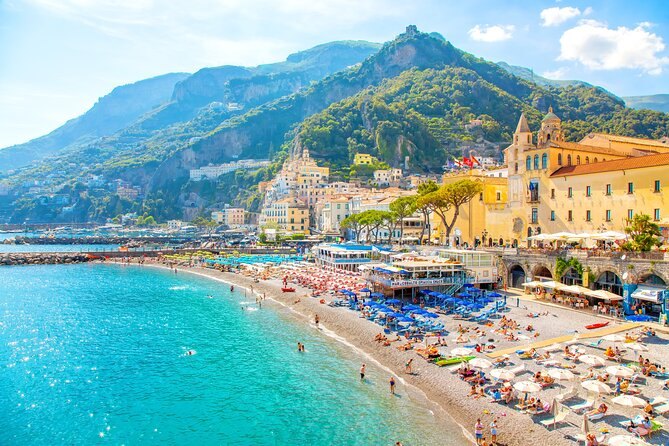
Nothing on the Amalfi Coast requires a tour. There is no gate and no ticket, the SITA buses run the coast road all year, and the ferries are the pleasantest transport in the region for half of it. This guide sets out how to do the coast independently, what it costs in time rather than money, and the point at which paying somebody starts to make sense.
Can you do the Amalfi Coast independently?
Yes, and plenty of people should. The coast is public: thirteen working towns, a state road and a ferry network. Nothing is gated, nothing needs a reservation, and the two things that do charge admission — the Ravello villas and the Grotta dello Smeraldo — are not included in any tour here anyway.
What a tour buys is not access. It is the driving, the parking, the timetable and somebody who knows which restaurant is worth the walk. Whether that is worth the money depends entirely on how much time you have and how much of it you are willing to spend on logistics.
The SITA bus, honestly
SITA Sud runs the scheduled service along the SS163 and it is genuinely good value. The route from Sorrento to Amalfi via Positano is one of the great bus rides anywhere, you sit high enough to see over the parapet, and it costs a few euro.
Three things to know. Buy the ticket before you board, from a bar or a tabaccheria, because drivers do not sell them. Expect to stand in July and August, and expect to watch at least one bus go past full at Amalfi. And build slack into the day, because the bus is subject to the same road as everything else.
The ferries, and their season
Better than the bus in every way except availability. Operators including Travelmar, Alicost, NLG and Positano Jet work the route roughly April to October, linking Salerno, Vietri, Cetara, Maiori, Minori, Amalfi, Positano and Sorrento. Salerno to Amalfi takes about twenty-five minutes against an hour by road.
They stop for the winter. From November to March there is no passenger boat on this coast at all, which is the single fact that makes an independent winter visit harder than a summer one. The getting-there page has the arrival routes in full.
Hiring a car
Possible, and rarely the relaxing option people imagine. The SS163 is fifty kilometres of two-lane road with over a thousand bends; parking in Positano and Amalfi is scarce and expensive in high season; and an alternate-plate scheme closes the road between Vietri sul Mare and Positano to half of all number plates between 10:00 and 18:00 on the busiest dates. Motorbikes, residents, blue-badge vehicles, taxis and buses are exempt.
Out of season, with confidence on narrow roads and somewhere to park, a car is a genuine pleasure here. In August, on a first visit, it is the thing most likely to spoil the day. Driving the coast covers the leg-by-leg times and the parking.
The four channels compared
| SITA bus | Ferry | Hire car | Guided day | |
|---|---|---|---|---|
| Cost | A few euro a leg | Modest, per leg | Hire, fuel, tolls and parking | From $109 a person |
| Season | All year | April to October | All year | All year on the road |
| Speed | Slow | Fastest between towns | As slow as the traffic | Same road, someone else driving |
| Flexibility | Fixed timetable | Fixed timetable | Total | Fixed, or total if private |
| Reaches Ravello | Yes, by connecting bus | No | Yes | Yes |
| Reaches the coves | No | No | No | Only by boat |
| Effort | High | Low | Very high in summer | None |
What does a guided day actually buy?
Four things, and it is worth being precise about them rather than vague. First, the driving and the parking, which on this road is the bulk of the difficulty. Second, the timing: a guided day reaches Positano before the crowd because it left at eight, and you probably would not have. Third, on the shared road days over seven travellers, a licensed guide with live commentary. Fourth, on a boat day, access to water you cannot otherwise reach.
What it does not buy is entry to anything, because there is nothing to enter. That is worth knowing when you compare a $110 day out against a bus fare: you are buying logistics and a guide, not admission.
When independent is clearly right
- You are staying on the coast rather than in Sorrento, so you are not crossing the peninsula to start.
- You have four days or more, and losing an afternoon to a bus is not expensive.
- You are going between April and October, when the ferries are running.
- You want one town properly rather than three in passing.
- You are on a budget where $110 a head is the difference between two nights and three.
When it clearly is not
- You have one day, and it is your only one.
- You are arriving on a cruise ship with a fixed re-boarding time.
- You are travelling in November to March, when the ferries have stopped and the buses are the only public transport.
- You want to swim in the coves, which have no road and no bus.
- Anybody in the party has a mobility need, since one private minivan states a wheelchair-accessible vehicle and no bus timetable makes any such promise.
What it costs either way
Do the arithmetic honestly. Two adults doing Sorrento–Positano–Amalfi and back by bus will spend perhaps fifteen to twenty euro between them and something between ninety minutes and two and a half hours waiting and standing. The same two on a shared guided day spend around $220 and lose nothing.
Put a value on your own time and the answer falls out. On a two-week holiday the bus is obviously right. On a three-day stop it usually is not. What each fare covers, and what you still pay on the day either way, is set out in the prices guide.
Walking: the Path of the Gods
The one genuinely great independent day here, and no tour is needed for it. The Path of the Gods runs about 7.8 kilometres along the ridge from Bomerano, in Agerola, at roughly 635 metres, down to Nocelle at about 430. From Nocelle you take the local bus down into Positano or you walk the staircase, which is over 1,500 steps.
Getting to Bomerano is the only logistical problem, and a bus from Amalfi solves it. The view from that ridge is the best on this coast that does not involve a boat, and it costs a bus fare.
How long does independent travel actually take?
Put real numbers on it, because "the bus is cheap" is only half a sentence. Sorrento to Positano on the SITA bus is about an hour once you have found the stop and waited for a bus with room on it. Positano to Amalfi is another forty to fifty minutes, plus the wait. Amalfi up to Ravello is a separate connecting bus and another half hour each way.
Do all of that in a day and you have spent roughly three hours moving and perhaps an hour and a half waiting, against about four hours moving and no waiting on a guided day that also left earlier. The ferry changes the picture completely where it runs: Salerno to Amalfi in twenty-five minutes, Amalfi to Positano in about the same, on a timetable you can read in advance.
The practical conclusion is that independent travel works well along the water and badly up the hills. Ravello, Scala and Tramonti are all a connecting bus away from the coast road, and that connection is where an independent day quietly loses its afternoon. If those towns are on your list, that is the strongest single argument for a vehicle with a driver in it.
A hybrid that works
The plan most experienced visitors end up with is neither pure. Use the ferries and the buses for the town-to-town movement, which they do well and cheaply, and buy exactly one thing: a boat day, because it reaches water no public transport goes near. That gets you the coast that has a road and the coast that does not, for the price of a single excursion.
If you would rather see what the guided options actually include before deciding, they are all on Amalfi Coast Italy Tours with their inclusions and exclusions listed.
Frequently asked questions
How do the SITA buses work?
Do the ferries run all year?
Should I drive the coast road myself?
What is the alternate-plate rule on the coast road?
Do I have to pay to enter anything?
The one thing worth buying
Full-Day Amalfi Coast Experience from Sorrento, Naples or Salerno
The cheapest guided road day, if the bus timetable defeats you.
From $110 per person
Check AvailabilityAmalfi Coast & Positano: Boat Tour with Snorkeling & Drinks
The coves and caves, which no bus or ferry will take you to.
From $110 per person
Check AvailabilityPrivate Tour Amalfi Coast from Sorrento
Nine hours and a driver, for the days when public transport will not do.
From $331 per person
Check Availability